

August 24, 2026
Persian Bijar Rugs: History, Designs & the Iron Rugs of Persia
Bijar rugs are Persian carpets from Kurdistan Province in western Iran. Dense construction, rich color, Herati and medallion designs, and the famous “Iron Rugs of Persia” nickname explained for shoppers.
Persian Bijar rugs are hand-knotted carpets associated with the town of Bijar and the surrounding weaving region in western Iran. They are especially known for dense construction, strong wool pile, rich Persian color, floral and geometric designs, and a substantial weight that feels different from many other handmade rugs when you lift a corner.
“Bijar rug” can mean a carpet tied to the town itself or to the wider regional tradition around it. Village and regional weaving matter as much as any single workshop. Not every Bijar was woven inside one city loft. What they share is tightly packed structure, durable wool, and drawing that ranges from intricate all-over fields to strong central medallions.
What Is a Persian Bijar Rug?
A Bijar rug is a Persian rug from Iran. The town of Bijar sits in Kurdistan Province, an area with a strong Kurdish cultural presence. Bijar has long been recognized as an important Persian carpet-weaving center, and antique examples from the region still turn up in American and European houses for good reason.
Think of Bijar as Persian carpet design meeting Kurdish regional heritage and village craftsmanship. The rugs belong to the broader world of Persian weaving. Their Kurdish regional identity is part of that story, not a separate category that cancels out “Persian.”
Where Do Bijar Rugs Come From?
Bijar is a town in Kurdistan Province in western Iran, in the wider carpet-producing landscape of western and northwestern Persia. Historically it sat along routes connecting important regional centers.
The short answer for shoppers is simple: Bijar rugs are Persian rugs from Iran. Their strong Kurdish regional heritage is an important part of their identity. A useful way to say it is this: Bijar is a Persian rug tradition from a predominantly Kurdish region of Iran. “Persian” and “Kurdish” are not mutually exclusive here.
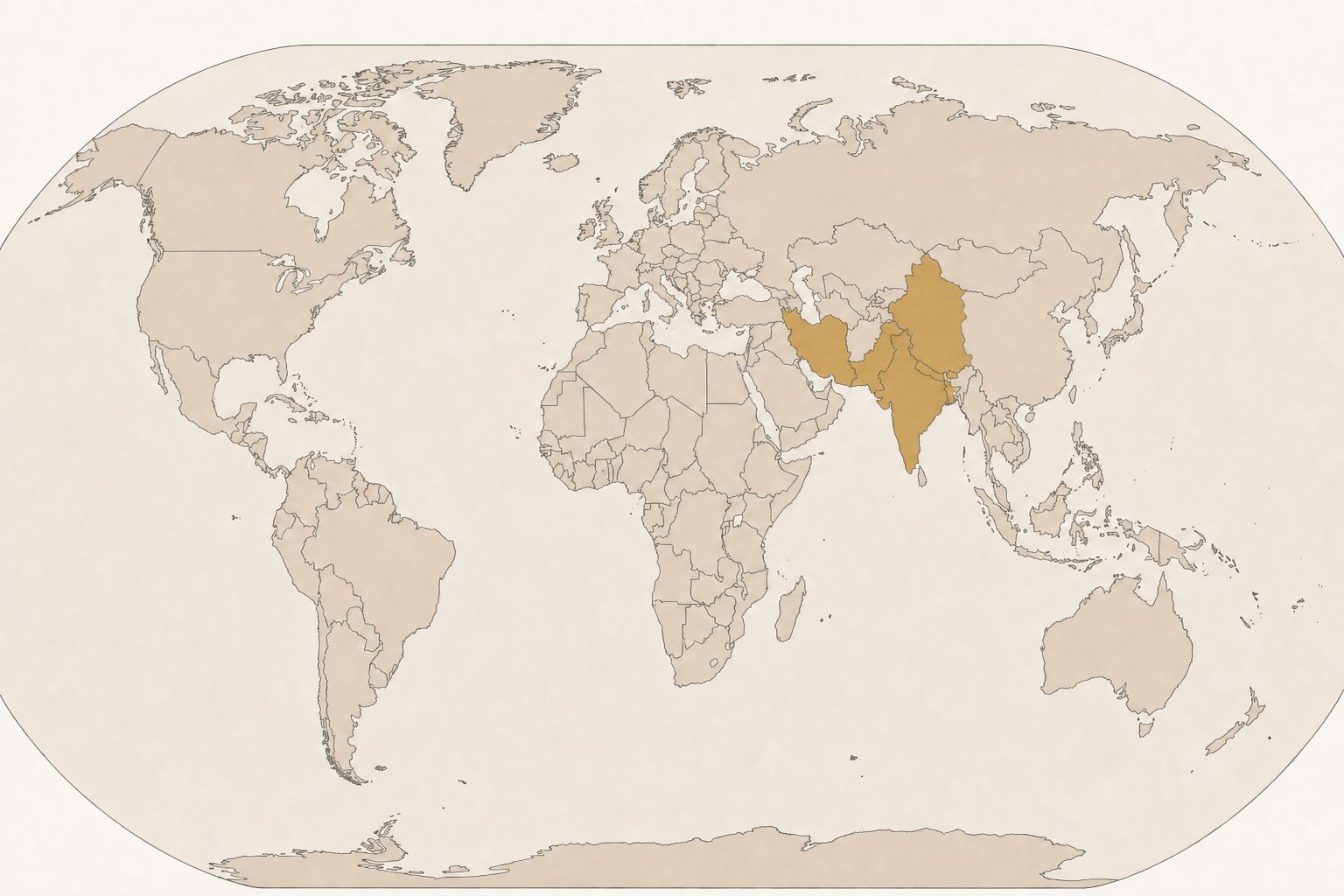
Historic weaving is Iranian. Later workshops in India and Pakistan also copy Bijar-looking patterns. We mark origin on the map and on the tag.
Kurdish Heritage of Bijar Rugs
The Bijar area is strongly associated with Kurdish communities, and Kurdish weaving traditions form an important part of the region’s textile heritage. Regional weaving historically existed through towns, villages, households, and local workshops. Those conditions helped produce rugs with a strong regional identity rather than the extremely standardized look of some large urban carpet workshops.
That does not mean every Bijar was woven by a nomadic Kurdish tribesperson. Many Bijar carpets were produced in settled communities. Calling them simply “tribal rugs” misses the point. Bijar weaving sits at the meeting point of Persian carpet tradition, Kurdish regional culture, and village craftsmanship.
History of Bijar Rug Weaving
Bijar developed into an especially important carpet-producing center during the 19th century, although textile traditions in the wider region have deeper roots. We do not invent a precise founding date. What we can talk about with confidence is the period well represented by surviving antique carpets.
During the 19th and early 20th centuries, Bijar carpets became increasingly recognized in the international Persian rug trade. Large Bijar carpets were exported and became desirable for substantial European and American interiors. Some particularly impressive antique examples were woven in very large room sizes.
Antique Bijar production ranged from smaller village rugs to large and sophisticated carpets. Not every Bijar is a rustic small rug.
How Are Bijar Rugs Made?
Bijar rugs are famous for their unusually compact and substantial construction. This is one of the most important things to understand about the type.
Traditional Bijar weaving often packs the structural elements of the rug extremely tightly. After rows of knots are tied, the weft threads that run across the rug are packed firmly into the foundation. Certain Bijar structures use multiple weft passes, including characteristic triple-wefted constructions. You do not need to identify all three wefts yourself. What you can feel is the result: a rug that can feel dense, heavy, firm, substantial, and less floppy than many other Persian rugs.
Handled next to a softer, more flexible carpet, the difference is often obvious. That dense structure is one of the most recognizable physical characteristics of the tradition.
Not every Bijar ever made has exactly three wefts. Regional and historical variations exist. Words such as “traditionally,” “often,” and “many examples” are more honest than universal claims.
Bijar carpets are hand-knotted: the pile is built row by row by tying individual knots around the foundation. Structural variations occur within the wider tradition. One knot type alone does not prove a rug is a Bijar. Identification should consider structure, materials, design, color, origin, age, and overall weaving characteristics. Most customers do not need to memorize knot terminology.
Traditional materials
Traditional Bijar rugs are most strongly associated with wool pile. Many antique Bijar carpets use wool pile on cotton foundations. Older regional and village pieces can vary and may include wool foundations. Not every Bijar is wool on cotton.
The pile is the visible wool surface you walk on. The foundation is the underlying structure that holds the rug together. Good wool gives texture, warmth, depth of color, resilience, and a substantial surface. Quality still varies from piece to piece. We do not credit one magical breed of sheep for Bijar durability.
The “wet weaving” story
Some rug literature and dealers describe traditional Bijar production as involving wool or woven sections being dampened during weaving so the structure could be packed tightly. That story is part of trade lore. It should not carry the entire explanation of Bijar’s reputation.
We do not state that every historic Bijar was repeatedly soaked with water. Descriptions of Bijar weaving often refer to techniques used to help compact the structure. The most important visible characteristic is still the exceptionally firm packing of the foundation.
Why Are Bijar Rugs Called the Iron Rugs of Persia?
Bijar rugs have long been nicknamed in the rug trade “the Iron Rugs of Persia” or “Iron Rugs of Iran.” That is a trade nickname, not an official historical title.
The nickname refers to dense construction, substantial weight, firm foundations, strong wool pile, and the ability of well-made examples to withstand years of household use. Bijar rugs do not literally contain iron. They are not indestructible. They are not scientifically proven to be the strongest Persian rugs.
What is fair to say is this: their unusually compact construction earned them an enduring reputation as some of the most substantial carpets in the Persian weaving tradition. An antique rug must still be judged by its individual condition. A 100-year-old Bijar with significant wear should not be treated as indestructible simply because the label says Bijar.
The Classic Bijar Look
There is not one single Bijar pattern. Bijar rugs can range from densely patterned all-over carpets to strong central-medallion designs.
Common visual characteristics include detailed floral ornament, repeating geometric structures, small flowerheads, palmettes, leaves, vines, rosettes, boteh (the paisley-like form), central medallions, corner spandrels, and dense all-over patterning. The drawing often combines floral Persian motifs with a stronger, more geometric regional interpretation.
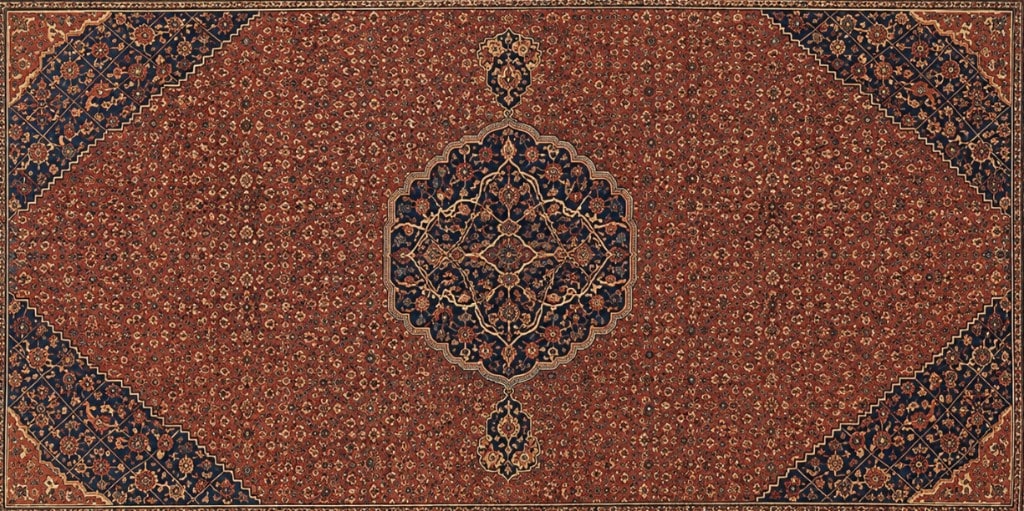
Some Bijars look extremely intricate. Others use larger and more open patterns. Not every Bijar must look like one particular red medallion rug. The cover on this page is one classic layout: a deep red field packed with small Herati motifs, a dark blue lobed medallion with pendants, matching blue corners, and an ivory main border.
What Is the Herati Pattern?
The Herati pattern is one of the designs strongly associated with Bijar rugs. In plain language, it usually consists of a repeating diamond-shaped arrangement around a central flower or rosette. Curved or serrated leaves appear around that center. The whole unit repeats across the field.
From a little distance, a Herati Bijar can read as a rich continuous field of red, blue, and cream. Up close, you begin to see hundreds of small flowers, leaves, and geometric details. That ability to work visually from both near and far is part of the design’s appeal.
In the carpet trade the Herati pattern is sometimes informally called the fish pattern or mahi design, because certain curved leaves have been interpreted as fish. That is a traditional name and a visual interpretation. The design does not literally depict fish in every case.
Medallion and All-Over Bijar Designs
Bijar medallion rugs
Many Bijar rugs use a prominent central medallion. It may be round, diamond-shaped, oval, lobed, floral, or geometric. Pendant forms may extend toward either end of the carpet. Corner sections can echo the shape or colors of the center.
Medallion Bijars can have an especially strong formal appearance. The medallion gives the eye an immediate focal point while dense flowers or Herati motifs fill the surrounding field. Not every Bijar has a medallion.
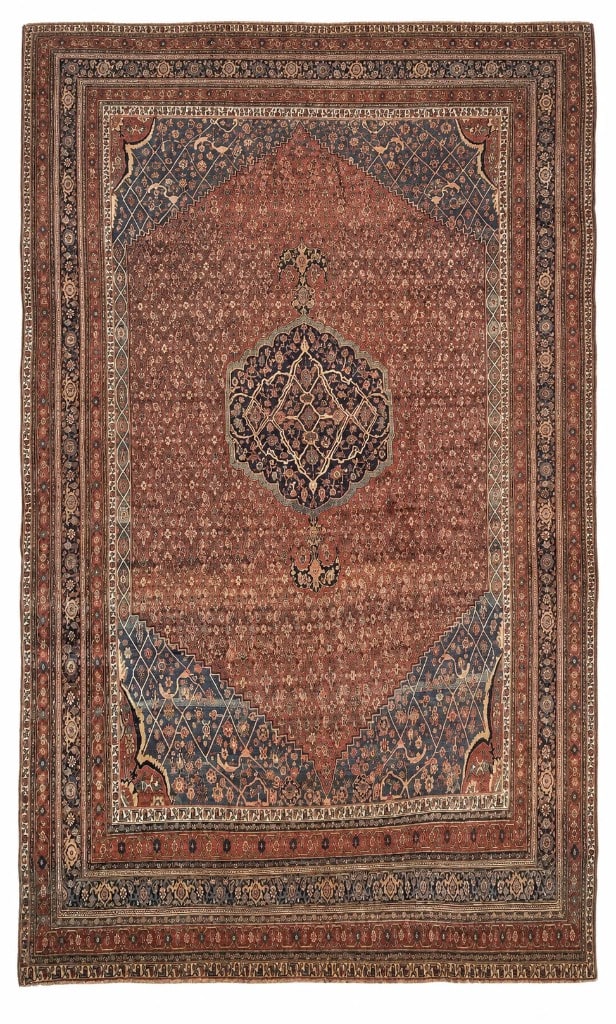
This one is in the Atlanta showroom. T-3522 is an antique Bijar, 13' x 21'7". It is a large room-size plan: a navy lobed medallion with pendants on a rust-red Herati field, matching navy corners, and a deep border with palmettes. The packing of small flowers across the field is the kind of dense drawing Bijar is known for. See it on the floor, or ask us to pull it when you visit.
All-over Bijar rugs
Many Bijars have no dominant central medallion. Instead the entire field may be filled with repeating Herati motifs, floral sprays, palmettes, arabesques, boteh, or lattice designs.
Those rugs can be particularly easy to use beneath dining tables or furniture, because the design is distributed across the whole carpet rather than depending on one visible center. If chairs and a table cover part of the field, the pattern still reads as complete.
What Is a Garrus Bijar Carpet?
Customers researching important antique Bijar carpets may encounter the terms Garrus, Garus, or Gerus. Spellings vary in English-language rug literature.
Garrus was a weaving center or district near Bijar in Persian Kurdistan and became associated with an especially recognizable group of carpets. The famous Garrus design often features large interlocking arabesques, split palmettes, floral sprays, scrolling forms, repeating lattice-like structures, and large-scale all-over compositions.
The design has a long Persian artistic ancestry. Related interlocking arabesque designs can be traced back to earlier Persian carpets, and versions became strongly associated with the Garrus / Bijar region by the 19th century.
Two accuracy points matter for shoppers:
- Not every rug with a Garrus design was woven in Garrus. The pattern became associated with the area but was not exclusive to it.
- Not every Bijar rug uses the Garrus design.
Garrus vs. a typical Herati or medallion Bijar
Typical Herati or medallion Bijar may feature dense repeating Herati motifs, strong central medallions, smaller floral details, and compact overall drawing.
Garrus Bijar often features larger arabesques, large split palmettes, more sweeping floral forms, and a broader, more architectural all-over pattern.
Both belong to the larger Bijar-region story. They can look dramatically different. That is one reason customers should not expect all Bijar carpets to resemble one another.
Traditional Bijar Rug Colors
Antique Bijar carpets are often known for rich and sophisticated color: deep madder red, brick red, rust, burgundy, dark navy, indigo-like blue, medium blue, ivory, camel, brown, gold, mustard, green, rose, soft coral, and light blue accents.
Rich red fields and deep blue borders are common. They are not required. Some antique Bijars have blue fields. Others may use ivory, camel, or other ground colors. Garrus carpets can also display surprisingly varied palettes. Color alone does not authenticate a Bijar.
Older Persian carpets traditionally used natural dye sources before synthetic dyes became widespread. Important traditional colors could be created using materials such as madder and indigo. Not every antique Bijar uses exclusively natural dyes, and not every newer Bijar uses synthetic dyes. Periods and individual rugs vary.
Abrash means subtle changes in color that occur when different batches of dyed wool are used during weaving. A red field may gradually become slightly darker or lighter in one section. That can be part of the individual character of a handmade carpet. It should not automatically be viewed as a defect.
Antique vs. New Bijar Rugs
Many of the antique Bijar carpets customers encounter today date from the 19th and early 20th centuries. These examples can be especially desirable for old wool, rich color, dense construction, individual drawing, patina, historical character, and traditional Persian craftsmanship.
Antique rugs may naturally show lower pile, abrash, minor repairs, slight irregularities, edge restoration, and wear associated with age. Serious damage should not be romanticized. Condition remains important. An antique Bijar should be evaluated individually based on age, quality, condition, size, design, color, and overall appeal.
Bijar weaving did not disappear with the antique period. Persian Bijar carpets continued to be woven through the 20th century and into more recent periods. Newer examples may retain traditional Herati designs, central medallions, red and blue palettes, floral borders, and dense Bijar construction.
A newer Bijar is not automatically inferior to an antique one. Some customers prefer a newer rug because it offers more pile, less age-related wear, strong practical usability, traditional Persian design, or a different price point. Age alone does not determine quality. A beautiful newer Bijar can be a better rug for one room than a heavily worn antique example.
Antique Bijar. Age, patina, historical interest, older colors, individuality, collectibility, and traditional character.
Newer Bijar. Fuller pile, strong everyday usability, more consistent condition, traditional design without extensive age, and specific sizes or colors.
Why Bijar Rugs Feel Different From Other Persian Rugs
If you handle several Persian rugs, a Bijar can often feel noticeably firmer and heavier. A fine Kashan or Tabriz may feel relatively flexible and emphasize detailed curvilinear drawing. A Heriz may emphasize bold geometric scale. A Bijar often combines intricate Persian pattern with an unusually compact physical structure. These are general tendencies, not absolute rules.
Knot count is not the sole measure of quality. These rugs are admired for structure, wool, design, color, drawing, proportion, craftsmanship, and condition. The rug with the highest knot count is not automatically the best rug. Bijar’s substantial character comes from overall construction, not simply from packing the maximum number of knots into each square inch.
Are Bijar Rugs Durable?
Bijar rugs have earned a strong reputation for practical use because of their dense construction. Well-preserved examples can work beautifully in living rooms, dining rooms, libraries, offices, entry areas, and family rooms.
Condition matters greatly with antiques. A heavily worn antique should not automatically be placed in an extremely demanding area simply because the label says Bijar. Evaluate each rug individually. No handmade antique rug is indestructible.
Because Bijar rugs can be dense and relatively stiff, handle them carefully. Do not aggressively fold a stiff antique Bijar if rolling it is safer. Useful habits include regular gentle vacuuming, rotating the rug periodically, using an appropriate rug pad, cleaning spills promptly, and having significant stains, repairs, or deep cleaning handled professionally. Do not steam-clean or shampoo a valuable handmade rug yourself.
How to Decorate With a Bijar Rug
Bijar rugs can work surprisingly well in both traditional and contemporary interiors. Their strong colors and detailed fields add warmth and visual depth.
They sit well with hardwood floors, leather, walnut and other dark woods, antique furniture, neutral upholstery, linen, contemporary furniture, stone, traditional millwork, and modern rooms that need color. A red-and-navy antique Bijar can anchor a quiet, neutral room. An all-over Bijar works especially well beneath a dining table because there is no single medallion that needs to stay completely visible. A medallion Bijar can become the visual center of a living room or library.
Why Bijar Rugs Remain Desirable Today
Bijar rugs offer a combination not found in exactly the same way in many other Persian weaving traditions: dense construction, strong wool, rich color, detailed Persian ornament, Kurdish regional heritage, antique availability, practical room sizes, and distinctive character.
Their patterns can reward close inspection while still making a strong impression from across the room. A good antique Bijar may already have survived generations of use. That helps customers appreciate both craftsmanship and history. Survival does not mean the rug requires no care.
Bijar rugs represent a distinctive carpet tradition from Persian Kurdistan in western Iran. Their identity was shaped by Kurdish regional culture, Persian carpet design, village and town weaving, wool traditions, historic trade, and generations of hand craftsmanship. The Herati pattern, central medallions, floral ornament, and Garrus arabesques may belong to the wider language of Persian carpet design. Bijar weavers gave them a distinctive physical and visual character.
Bijar is not simply one pattern. It is a regional weaving tradition defined by both design and construction.
If you want to see what that means in wool, browse Bijar rugs in our collection, or visit the showroom on Miami Circle in Atlanta.