

August 12, 2026
Bakhtiari Rugs: History, Designs & Heritage of Persian Bakhtiari Carpets
Persian Bakhtiari rugs come from western Iran, where tribal and village weaving meet. Garden panels, medallions, strong color, and wool built for rooms that get used.
Bakhtiari rugs are Persian hand-knotted carpets from western Iran, especially the country of the Bakhtiari people and the Chahar Mahal villages around them. They are known for strong color, a sturdy wool pile, and drawing that can look like a garden laid out in panels, or like a bold medallion in the middle of the floor.
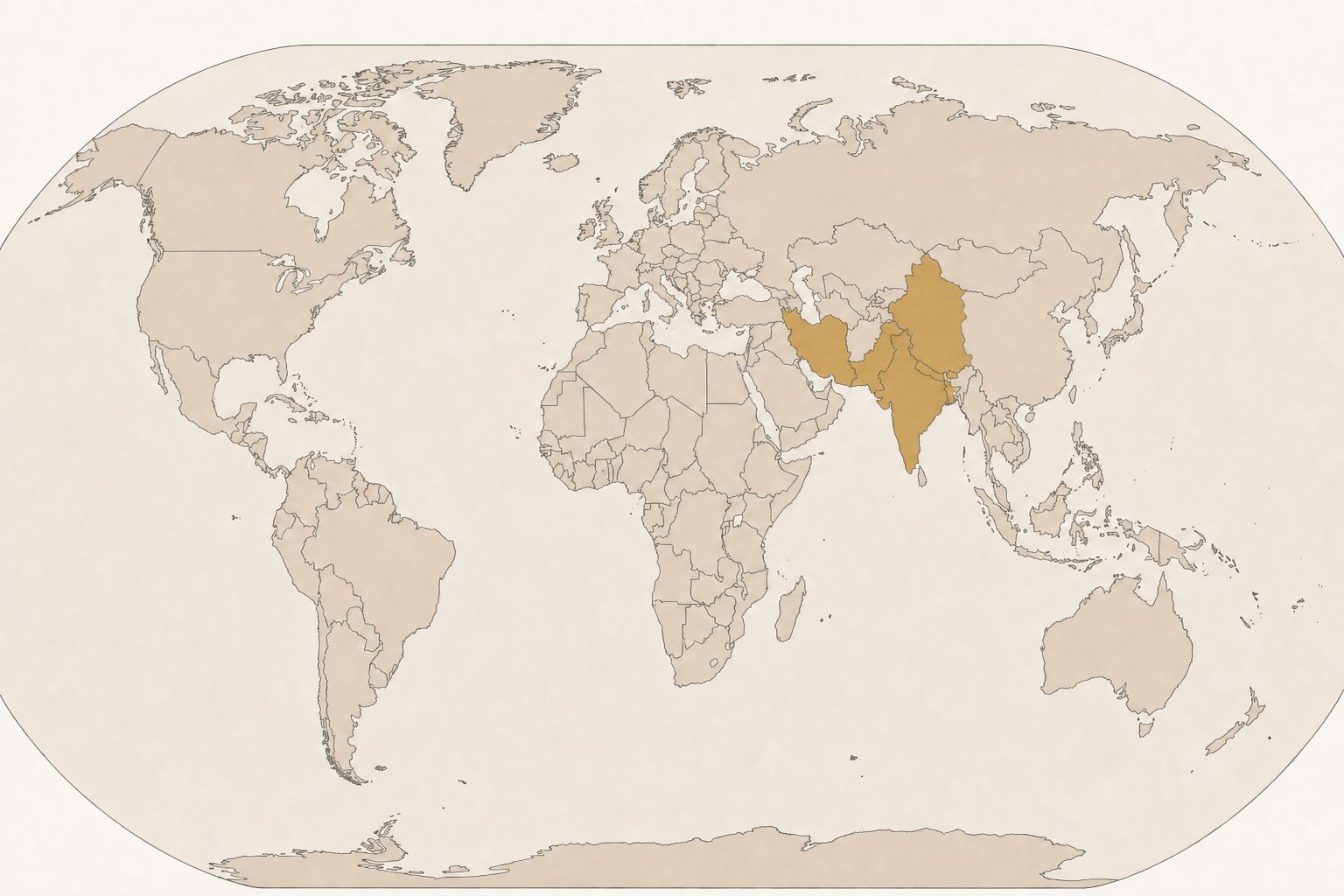
The Bakhtiari are a major tribal confederation historically tied to the Zagros Mountains of western and southwestern Iran. In the rug trade, though, “Bakhtiari” is not a promise that a nomadic tribesperson tied every knot. It grew into a regional name. Rugs called Bakhtiari may have been woven by Bakhtiari tribal communities, by settled Bakhtiari villagers, or by other village weavers in the same district. Many of the large antique carpets people put in living rooms came from settled villages in Chahar Mahal. Tribal and village work sit inside the same tradition. Not every Bakhtiari rug is a nomadic rug.
Historic weaving is Iranian. Later workshops in India and Pakistan also copy the garden-panel and medallion look. We mark that on the map and on the tag.
Where they come from
The traditional homeland is the Zagros in western Iran. The historic Chahar Mahal district is now part of Chaharmahal and Bakhtiari Province. You may see related names: Bakhtiari, Chahar Mahal Bakhtiari, Chahar Mahal, or a village name from the region. Those labels belong to connected weaving, not to three unrelated types.
It is a landscape of tribal movement, settled villages, farming, livestock, and looms in the same valleys. Carpet weaving grew up next to sheep, wool, and household life, not in a single royal workshop.
How the tradition developed
Bakhtiari communities and their neighbors have a long textile habit: raising sheep, spinning wool, weaving for the house, and living with pastoral work. The tradition did not start in one documented year. It grew over generations. What we can see clearly are surviving carpets from the nineteenth and early twentieth centuries. By then, Bakhtiari and Chahar Mahal rugs were a real part of the wider Persian carpet trade.
Weaving ranged from practical tribal textiles to large decorative carpets in settled villages. As demand for Persian carpets rose in Europe and beyond, rugs from this region moved into those markets. That is why so many antique Bakhtiari carpets still turn up in American houses.
Tribal work and village carpets
Traditional tribal weaving was tied to mobile or semi-mobile life. Households needed pieces they could pack: bags, saddle bags, storage weaves, smaller rugs, and other useful textiles.
Large room-size pile carpets were more often village work, sometimes in a workshop style. That is why many antique Bakhtiari carpets in homes today were likely woven in villages, not on migration. Both sides of the tradition matter. One kept the wool and the motifs close to daily life. The other made the grand floors.
How they are made
Traditional Bakhtiari rugs are hand-knotted pile rugs. The surface you see and walk on is generally wool. Underneath is the foundation, the structural grid that holds the knots.
That foundation may be cotton or wool. Village rugs often use cotton. More tribal examples may use wool throughout. Not every Bakhtiari is wool pile on cotton.
In the trade they are often associated with the symmetrical knot, also called a Turkish or Gördes knot. A knot type alone does not prove a rug is Bakhtiari. What you can feel is the labor: row after row of hand-tied pile, sheared, and built to last.
Wool was the natural material in a sheep country. Good wool gives warmth, a substantial hand, and the durability people expect from these carpets. Quality still varies from piece to piece.
The garden-panel design
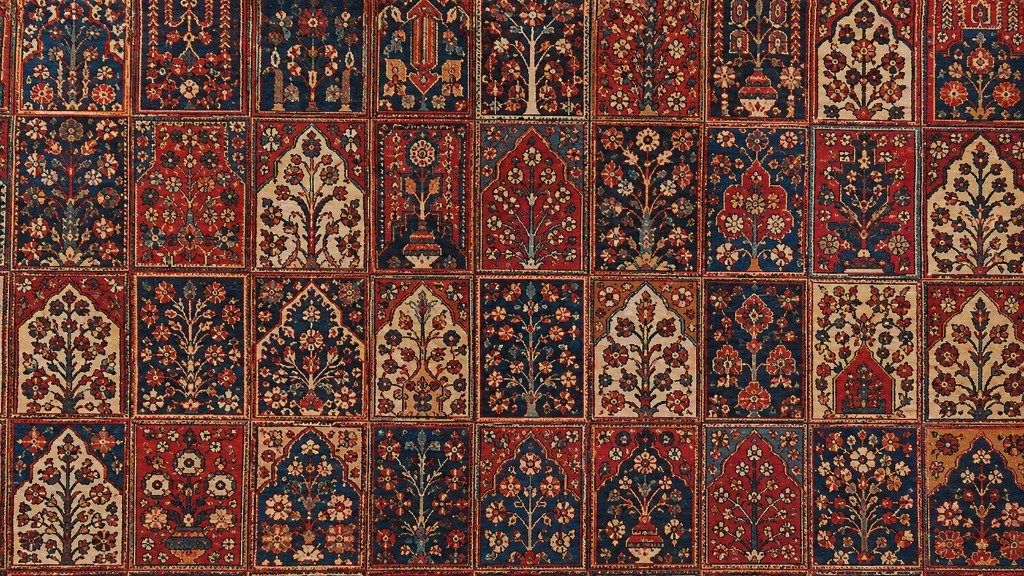
The classic Bakhtiari garden, compartment, panel, or kheshti design is the one many people picture first. The field is divided into squares or rectangles, like a quilt of little gardens. Each panel can hold its own motif: a flowering plant, a tree, a cypress, a willow, a vase, a bouquet, a rosette, a boteh (the paisley-like form), a bird, an animal, or a geometric ornament.
From across a room it can look like a patchwork of miniature garden scenes, each with its own flowers or trees, held together by the grid. Dealers also call this a garden-panel or compartment design. The cover on this page is that look: repeating boxes, each a small planted world.
Gardens run through Persian art: architecture, painting, textiles, and carpets all return to plants, trees, water, and ordered landscape. The Bakhtiari compartment pattern fits that taste. It does not mean every panel rug is a map of one famous garden, or a literal copy of the classical chahar bagh plan. Divided spaces, flowers, and trees simply belong to the same Persian love of a cultivated garden.
Not every Bakhtiari is a garden rug
The panel design is famous. It is not the only drawing.
Medallion. Many Bakhtiari rugs have a large central medallion and corners that echo its shape or color. The layout is one you see across Persian weaving. Bakhtiari versions often look bolder and more geometric than a fine city rug.
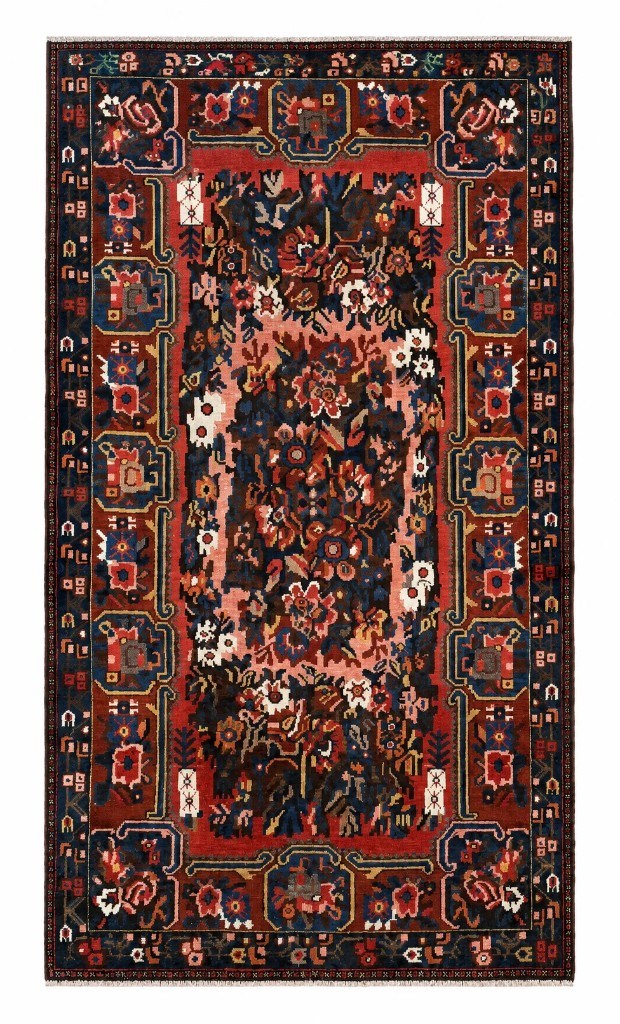
This one is in the showroom. T-1768 is a semi-antique Bakhtiari, 5' x 8'3", with a nested medallion on a madder field, navy, gold, and a coral band around the center. The drawing is floral but more geometric than a fine city Kashan, which is typical of the type. It is a smaller format than the grand village carpets, and it still shows the saturated color people look for. See it on the floor, or ask us to pull it when you visit.
Trees. Cypress and other stylized trees appear on their own, in rows, or inside compartments.
Floral. Rosettes, palmettes, flowering branches, leaves, vines, bushes, and flowering trees are common. Next to a very fine Isfahan or Kashan, Bakhtiari floral drawing often feels bolder, more geometric, and more rustic. That is character, not clumsiness. The drawing is confident.
Prayer rugs. Weavers also made prayer rugs with a mihrab, the arched niche that orients the piece.
Animals and figures. Birds, animals, and occasionally people appear among flowers and trees: lions, deer, and other stylized forms. Figural rugs are part of the tradition. They are not the most common type.
Khan carpets and Bibibaf
Some important Bakhtiari carpets were commissioned for members of the Bakhtiari ruling elite, traditionally called khans. Those pieces show that the region did not only weave for the tent or the house. Some examples are large, fine, highly decorative, and made for wealthy or politically important patrons. A few documented carpets even carry woven inscriptions naming the person who ordered them. Bakhtiari weaving ran from practical household textiles to sophisticated commissions.
In the trade, Bibibaf (also written Bibi Baff) is a grade word for especially fine Bakhtiari weaving. It is not a separate Persian rug type. We do not treat stories about every such rug being woven only by grandmothers as fact. Collectors and dealers use the term when the knotting and finish are a step above the usual village carpet.
Colors
Antique Bakhtiari rugs are often easy to recognize by deep, saturated Persian color: madder red, brick, rust, burgundy, deep blue and indigo, ivory and cream, green, gold, mustard, brown, and soft blue.
Madder was historically important for red. Indigo was important for blue. That does not mean every Bakhtiari is naturally dyed. As commercial weaving grew, synthetic dyes entered the region too.
Abrash is a slight shift in shade when different batches of hand-dyed wool sit in one carpet. On a handmade antique, those changes can add depth. They are evidence of the process, not automatically a defect.
Built for rooms that get used
Bakhtiari rugs have a reputation for substantial construction: wool pile, sturdy weaving, and village origins that assumed the floor would be walked on. Many customers like them because they look decorative and still feel practical.
They are not “the strongest Persian rugs” as a scientific fact. A hundred-year-old carpet still has to be judged one at a time. Condition, foundation, and wear matter as much as the name.
Why they still work in a house
Bakhtiari rugs come from a place where tribal migration, village life, sheep, farming, family looms, Persian decorative art, and the commercial carpet trade all pushed on each other. Trees, flowers, gardens, animals, strong geometry, medallions, and compartment layouts grew out of that mix.
They were not designed in one centralized royal workshop. Villages and communities kept their own handwriting. Antique Bakhtiari rugs can differ a lot and still look like the same regional family. That variation is part of why people keep them.
Customers still want antique Bakhtiari rugs for the color, the garden and floral drawing, the hand-knotted wool, the substantial feel, and the mix of tribal and village heritage. Compartment designs give a room a lot to look at. Medallion and floral pieces sit well in living rooms, dining rooms, libraries, bedrooms, entries, traditional houses, and contemporary rooms that need warmth. The stronger geometry can contrast with a clean interior without feeling stiff.
Because they were handmade, shape, drawing, pile, color, and wear will not be factory-perfect. An antique Bakhtiari rug is more than a pattern on the floor. It is generations of Persian weaving, regional life, and craft shaped by both the tribe and the village.
Browse Bakhtiari rugs in our collection, or visit the showroom on Miami Circle in Atlanta.