

August 12, 2026
Agra Rugs: History, Design & Heritage of Indian Agra Carpets
Hand-knotted Indian Agra rugs grew out of Mughal court weaving. Here is how the tradition developed, what antique Agra carpets look like, and why they still work in a home today.
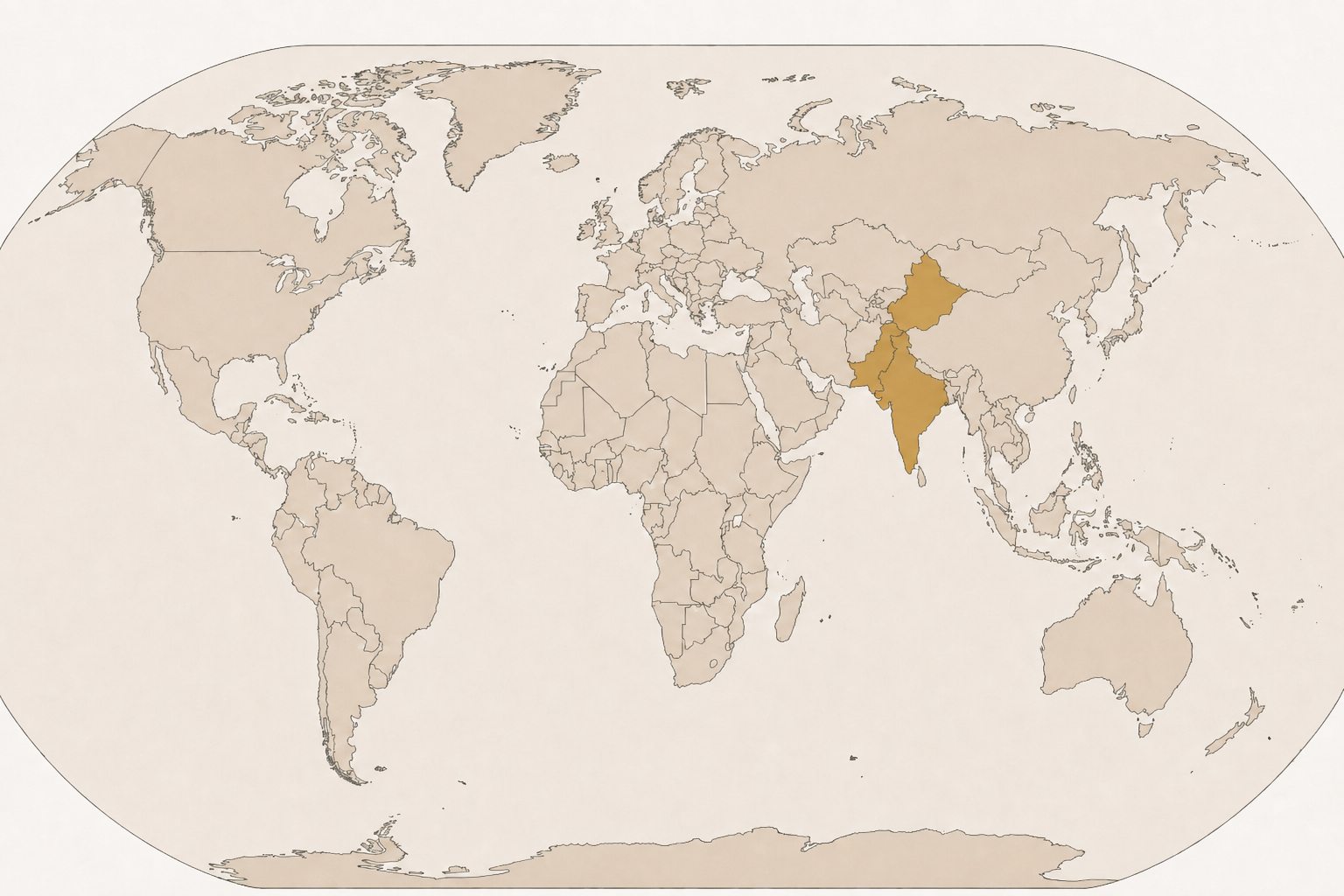
Agra rugs are hand-knotted carpets tied to Agra in northern India, one of the important weaving cities of the Mughal Empire. They are Indian rugs with a strong Persian influence, not “Persian rugs that happen to have been made in India.”
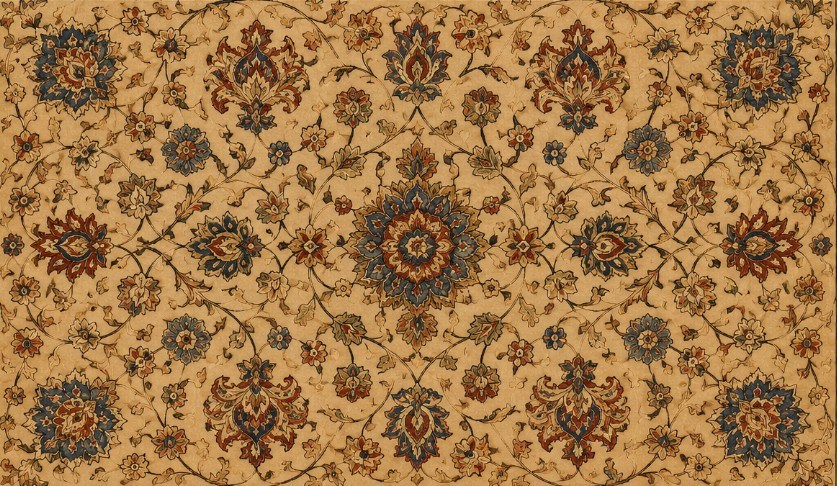
Persian and Safavid carpet design shaped the early court workshops. Indian craftsmen then built a Mughal style of their own, with Indian plants, animals, color, and a taste for gardens. That mix is what makes an Agra carpet feel different on the floor.
The name also covers more than one period. The tradition has roots in the late 1500s. Many of the antique Agra rugs people actually live with today were woven in the nineteenth-century revival, when Agra again made large decorative carpets for important rooms. Newer hand-knotted Indian rugs in Agra drawing are still made, including in related workshops in Pakistan. We say so on the tag.
Mughal origins
Court-sponsored pile carpets flourished under Mughal Emperor Akbar, who ruled from 1556 to 1605. He supported imperial workshops in Agra, Lahore, and Fatehpur Sikri, and brought skilled Persian and Iranian weavers into the court.
Akbar did not invent carpet weaving in India. Carpets already existed there. His reign is when sophisticated, large-scale imperial pile production took hold. Early Mughal carpets leaned hard on Persian and Safavid design. Over time, Indian weavers adapted those models until the work read as Mughal, not as a copy.
How the style became Indian
The Mughal court loved gardens, flowers, animals, and the natural world. Under later emperors such as Jahangir and Shah Jahan, especially in the seventeenth century, flowers and plants in Mughal decorative arts became more naturalistic and more central.
You will see tulips, lilies, carnations, roses, irises, poppies, flowering branches, palmettes, vines, and leaves. Some rugs place individual flowers in lattices or repeating compartments. Others send sweeping floral vines across the whole field. Earlier Mughal carpets can also include animals and birds: deer, ibexes, lions, birds, and mythical creatures. The floor, in other words, could feel like a garden.
Those floral forms belong to the same visual world as Mughal architecture, carved stone, textiles, painting, and palace decoration. Agra was a great center of that culture. It is also home to the Taj Mahal and Agra Fort. Agra carpets were not copied from the Taj Mahal. Carpets and buildings often shared a vocabulary: flowers, vines, lattice, symmetry, and elegant natural shapes. An antique Agra rug sits in that larger tradition.
How Agra rugs are made
Traditional Agra carpets are hand-knotted pile rugs. That means each knot is tied by hand around the warp, then the pile is sheared. It is slow work. A large carpet can take months.
Many antique Agra carpets, especially nineteenth-century pieces, have a wool pile on a cotton foundation. The wool is the soft surface you walk on and see. Cotton, underneath, is the structure that holds the rug together. Not every Agra is built exactly that way. Some especially luxurious Mughal court carpets used finer materials such as pashmina wool, silk, or silk foundations.
Historical Mughal carpets often use an asymmetrical, Persian-style knot. That is a workshop detail, not something you need to count in a living room. What you can see is the result: even pile, clear drawing, and a rug that was built as a serious textile.
On a fine antique, the pile is usually sheared even and kept relatively low, so palmettes and vines stay sharp instead of going fuzzy. You should be able to read the pattern from a few feet away. A coarse, floppy weave with muddy drawing is not what this name is for.
Designs you will see
There is no single Agra pattern. The drawing is what people recognize more than any one layout.
All-over floral. Large palmettes, flowers, vines, leaves, arabesques, and branches cover the field. This large-scale floral is one of the most familiar looks in antique Agra carpets.
Floral lattice. Flowers or flowering plants sit inside repeating geometric or vine compartments. That organization became especially important in the Mughal period.
Animal and garden. Some earlier Mughal carpets show birds, deer, ibexes, lions, trees, and flowers together, like a garden spread across the floor.
Medallion. Some Agra carpets have a central medallion or repeating medallions. A medallion is not required. Plenty of important Agras have none.
Persian-inspired drawing. In the Mughal period and in later revivals, weavers also worked from historic Persian ideas: large palmettes, Shah Abbas-style flowers, scrolling vines, cloud bands, saz-style leaves, arabesques, and compartments.
What often makes an Agra carpet land in a room is the scale and confidence of the drawing, especially on oversized pieces. The pattern is meant to be seen from across the floor, not only up close.
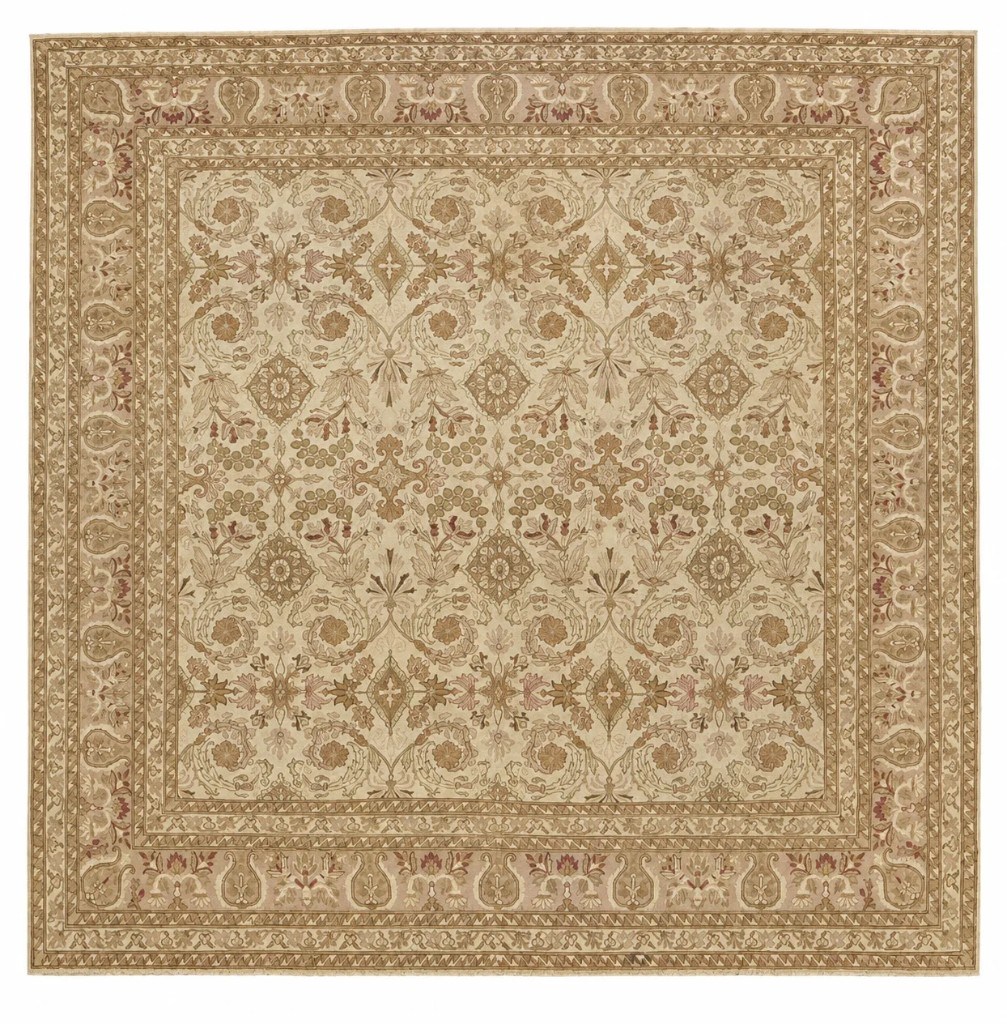
This one is in our Atlanta showroom. T-4111 is an antique fine Agra, almost square at 10'6" x 10'8". The field is a pale cream and tan all-over floral, with palmettes and vine-scrolls packed tightly but still readable. The pile is low and even, which is why the drawing stays this clear. It is a good example of the type at its most refined: large, light, and workshop-fine. See it on the floor, or ask us to pull it when you visit.
Colors
Agra rugs do not have one required palette.
Antique examples are often known for rich, sophisticated combinations: deep crimson, ruby and brick red, burgundy and claret, indigo and dark blue, ivory, pale blue, turquoise, sage and other greens, gold and mustard, rose and soft pink, and earthy neutrals. Traditional Agra color is those reds, golds, ivories, and related workshop tones.
Newer hand-knotted versions come in all colors. Pale creams, greys, greens, whatever a current room wants. The drawing can still be Agra. The palette does not have to match a nineteenth-century crimson field.
Older handmade rugs can also show abrash: slight shifts in color from one area to another. That happens when wool was dyed in different batches by hand. Abrash is part of the character of an antique, not a flaw. We do not claim every Agra uses natural dyes. That has to be true of the individual rug.
The nineteenth-century revival
After the height of the Mughal Empire, royal patronage declined and Indian carpet production changed. In the nineteenth century, weaving in northern India had an important revival. Agra became well known again for large decorative carpets inspired by earlier Mughal and Persian designs.
Many of the antique Agra rugs available to homeowners and designers today come from this period. They were often made on a grand scale for large rooms. Some historical examples run 15, 18, 20 feet or more in length. That size is one reason Agra carpets still work so well in living rooms, dining rooms, libraries, great rooms, entry halls, historic houses, and large contemporary interiors. The pattern has room to breathe. Furniture can sit on it without swallowing the design.
Agra jail carpets
Agra rugs did not begin in prisons. Most of this centuries-old tradition has nothing to do with prison production.
During British colonial rule in the nineteenth century, some Indian prisons ran weaving workshops where prisoners made carpets and other crafts. Agra was one of several places tied to that system. Some extremely accomplished carpets came out of those workshops, including large pieces for important colonial and international interiors.
This is part of the complicated history of nineteenth-century Indian carpet production. It is not a romantic story, and “Agra Jail” does not mean an inferior rug. Some surviving examples are highly sophisticated. It is one chapter in a much longer history that began centuries earlier under the Mughals.
Why they still matter
Agra rugs sit at a meeting of traditions: Persian and Safavid carpet design, Mughal imperial culture, Indian craftsmanship, Indian plants and animals, a court fascination with gardens, and the same decorative language found in architecture, painting, and textiles. The nineteenth-century revival then brought those historic designs back for large interiors.
The finest pieces show how Indian craftsmen took outside influence and made something distinctly Mughal and Indian. The layouts can feel architectural. The flowers and vines still feel alive.
Customers still look for antique Agra rugs because of that large-scale drawing, the color, the hand-knotted work, and the way they sit in a room. They complement antique furniture and older houses. They also add warmth and contrast in quieter contemporary rooms. Because each antique was made by hand, drawing, color, size, wear, and age will vary. That variation is the point.
An antique Agra rug is a floor covering, and it is also a handmade object tied to centuries of Indian and Mughal art. If you want to see what that means in wool, browse Agra rugs in our collection, or visit the showroom on Miami Circle in Atlanta.